Arms · Cable · Beginner
Rope Pushdown
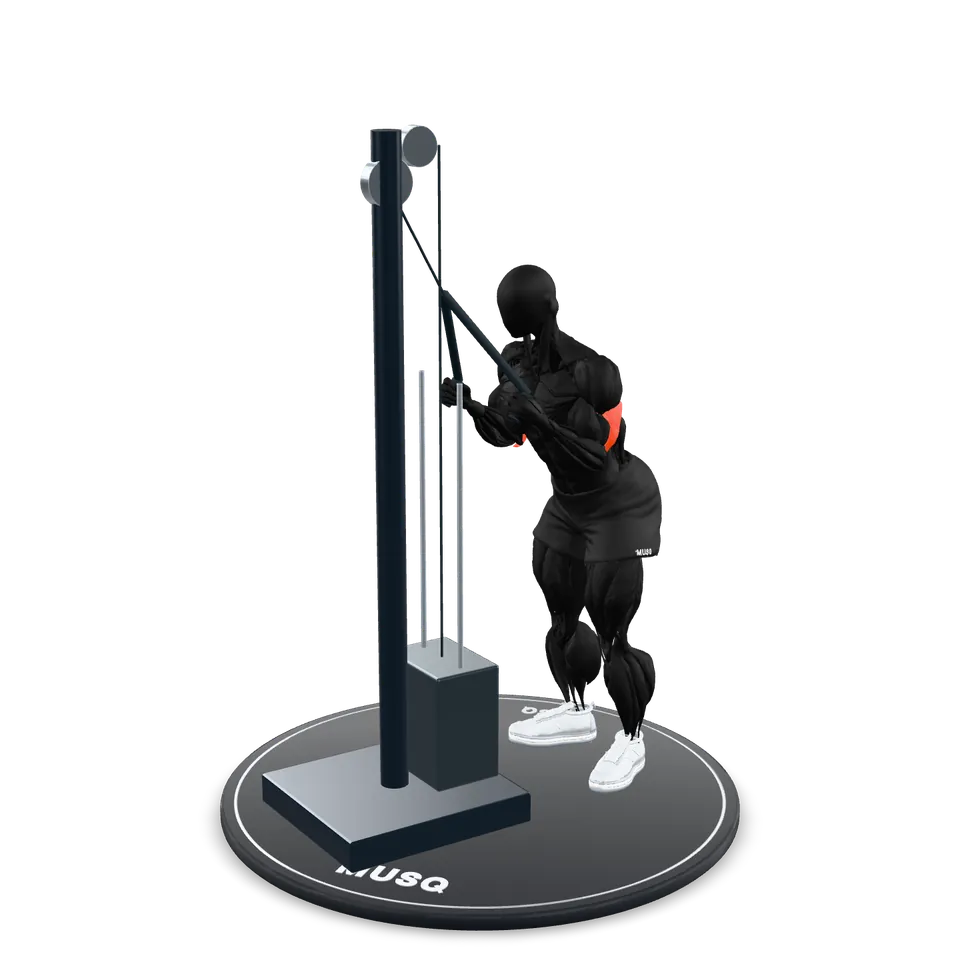
The rope pushdown, a version of the triceps pushdown, trains the triceps on a high cable. With your elbows pinned to your sides, you push the rope down until your arms are straight and spread the ends apart at the bottom. The cable keeps tension on the triceps through the whole rep.
- Primary muscles
- Triceps Brachii
- Equipment
- Cable
- Level
- Beginner
- Sets × reps
- 3–4 × 10–15
- Rest
- 60–90 s
Muscles worked
Estimated activation, matching the orange paint on the 3D model.
- Triceps Brachiiprimary
How to do the rope pushdown
- Attach a rope to a high pulley, hold one end in each hand and step close to the stack.
- Lean forward slightly from the hips with your feet planted and your shoulders down.
- Start with your elbows bent and pinned to your sides, hands around chest height.
- Push the rope down by straightening your elbows; only your forearms move.
- At the bottom, spread the rope ends apart and lock your arms straight.
- Let the rope rise slowly back to the start without letting your elbows drift forward.
Form cues and common mistakes
The same coaching points MUSQ shows on the lifter in the app.
Shoulder Position
The shoulders stay set so the arms can do the work.
Why it mattersRolling the shoulders forward and leaning over the handle lets body weight push it down.
Common mistakeHunching over the handle and shrugging the shoulders up.
Do this insteadKeep the chest up and the shoulders down and back.
Elbow Position
The elbows are pinned; only the forearms move.
Why it mattersPinned elbows make elbow extension the only motion, so the triceps move the load; elbows that drift forward bring the lats, chest and shoulders in.
Common mistakeElbows lifting and flaring forward as the handle comes up.
Do this insteadTuck the elbows against the sides of the torso and keep them there for the whole set.
Rope Split
The rope lets the hands finish wider than a bar.
Why it mattersPulling the rope ends apart at the bottom lets the hands pass the thighs, so the elbows reach full extension.
Common mistakeKeeping the hands together so the rope stops against the thighs short of lockout.
Do this insteadAs the hands pass the waist, spread the rope ends apart and finish with the arms fully straight.
Torso Angle
A slight lean gives the cable a clear path.
Why it mattersHinging a little forward from the hips lets the handle travel straight down past the body without catching on the torso.
Common mistakeLeaning further on every rep to push the stack with body weight.
Do this insteadHinge slightly forward, brace the core and hold that angle for the whole set.
Base
A still base keeps the body out of the lift.
Why it mattersA hip-width stance with soft knees gives a stable platform, so the triceps work against the full load.
Common mistakeStanding so close to the stack that the body sways with each rep.
Do this insteadStand hip-width, about a foot from the stack, with the knees slightly bent.
● Free on the App Store
Train every lift in 3D with MUSQ
Nearly 500 exercises in 3D, x-ray set-up demos, stretching and a plan built around the days you train. MUSQ is free on iPhone.
Rope Pushdown FAQ
What muscles does the rope pushdown work?
All three heads of the triceps, the muscle on the back of the upper arm. It is one of the simplest ways to isolate them.
Rope or bar for triceps pushdowns?
A straight or V bar lets you move a little more weight; the rope lets your hands spread at the bottom for a fuller lockout. Both build the triceps.
Why do my shoulders work in pushdowns?
Usually the elbows move forward and back, turning it into a press. Pin your elbows to your sides and lighten the weight.