Arms · Dumbbell · Beginner
Alternating Hammer Curl
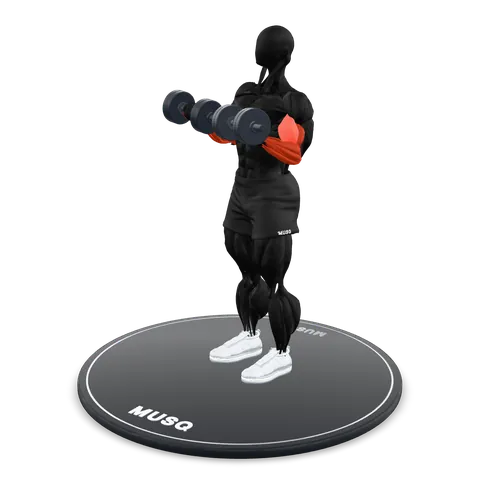
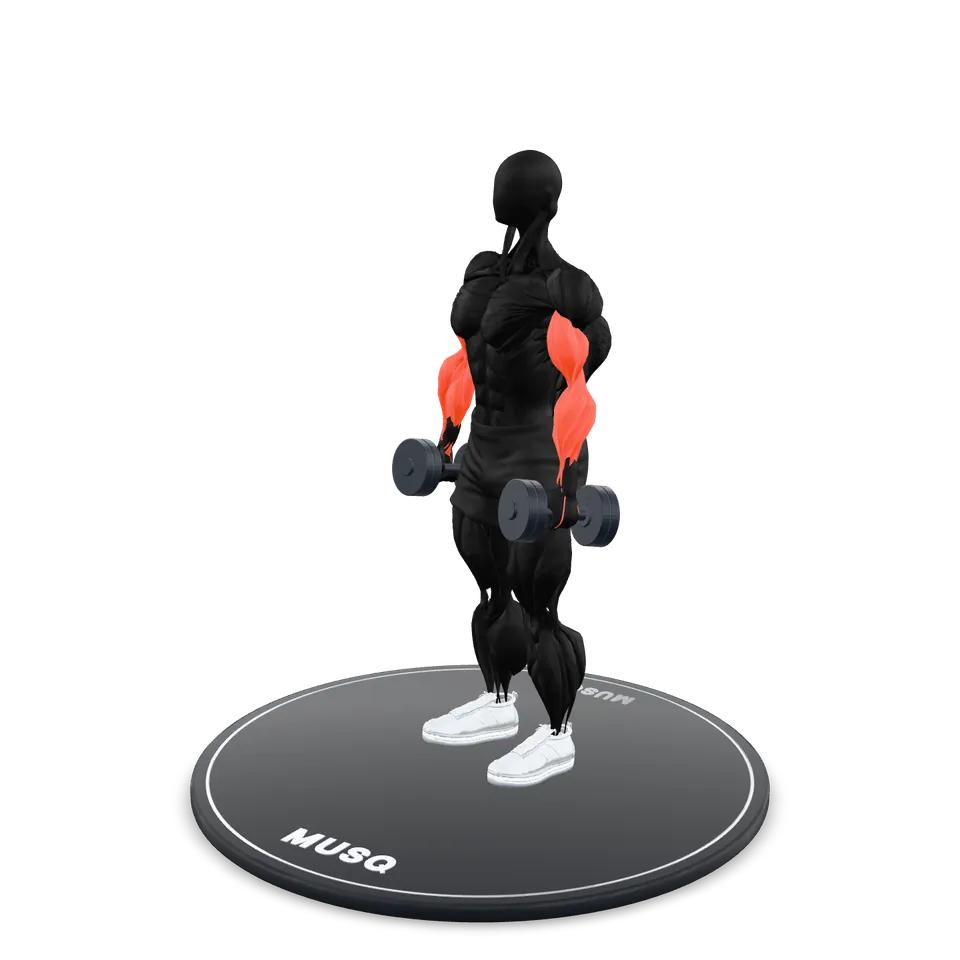
The hammer curl is a curl with your palms facing in, like holding a hammer. That neutral grip puts more of the work on the brachialis and the brachioradialis of the forearm, which add thickness to the arm. Here the arms take turns, one curl at a time.
- Primary muscles
- Brachialis, Biceps Brachii, Brachioradialis
- Equipment
- Dumbbell
- Level
- Beginner
- Sets × reps
- 3–4 × 8–12 per arm
- Rest
- 60–90 s
Muscles worked
Estimated activation, matching the orange paint on the 3D model.
- Brachialisprimary
- Biceps Brachiiprimary
- Brachioradialisprimary
How to do the alternating hammer curl
- Stand tall with a dumbbell in each hand at your sides, palms facing your thighs.
- Keep your shoulders down and your elbows close to your sides.
- Curl one dumbbell up by bending only at the elbow, thumb pointing up the whole way.
- Stop when your forearm is near vertical and squeeze for a moment.
- Lower it slowly to a straight arm, then curl the other side.
- Keep your body still; the weight should never swing up.
Form cues and common mistakes
The same coaching points MUSQ shows on the lifter in the app.
Shoulder Position
The shoulders stay set while the arms take turns.
Why it mattersShrugging or rolling the shoulders forward lets the upper traps and front deltoids help lift the dumbbell, taking work away from the elbow flexors.
Common mistakeShoulders shrugging up and rolling forward as each dumbbell comes up.
Do this insteadDraw the shoulders down and back before the first rep and keep them level and still for the whole set.
Elbow Position
The working elbow stays by your side.
Why it mattersWith the elbow fixed, bending it is the only motion, so the elbow flexors lift the weight. If the elbow drifts forward, the front deltoid joins in and the forearm reaches upright early, where the dumbbell stops loading the elbow.
Common mistakeThe working elbow drifting forward and up as the dumbbell rises, turning the top of the curl into a front raise.
Do this insteadKeep the elbow close to the ribs and curl until the dumbbell is in front of the shoulder, thumb up, letting the elbow come forward only slightly at the top.
Grip and Wrist
The palm faces in, thumb up, for the whole rep.
Why it mattersThe neutral grip is what makes this a hammer curl: the biceps, which also turns the palm up, has less leverage and does a little less, while the brachialis and brachioradialis keep lifting. Twisting the palm up turns it back into an ordinary curl, and a bent wrist takes needless load.
Common mistakeBending the wrist in toward the body as the dumbbell nears the shoulder.
Do this insteadHold each dumbbell like a hammer, palm facing in and knuckles in line with the forearm, and keep it that way from bottom to top without twisting.
Range of Motion
Each curl starts from a straight arm.
Why it mattersLowering all the way works the elbow flexors through their whole length, and full-range curl training has built more strength than partial reps.
Common mistakeLeaving the resting arm half-bent at the bottom and starting its next curl from there.
Do this insteadLower each dumbbell until the arm hangs straight by your side, palm facing in, before the other arm starts.
Body Swing
The legs and back stay out of it.
Why it mattersRocking the torso or pushing the hips forward borrows momentum from the hips and lower back, so the elbow flexors skip the hardest part of each curl.
Common mistakeLeaning back and pushing the hips forward to swing each dumbbell up.
Do this insteadStand tall with soft knees, brace the core and lower each dumbbell under control so the next rep starts from a still body.
● Free on the App Store
Train every lift in 3D with MUSQ
Nearly 500 exercises in 3D, x-ray set-up demos, stretching and a plan built around the days you train. MUSQ is free on iPhone.
Alternating Hammer Curl FAQ
What muscles do hammer curls work?
The brachialis, the brachioradialis on the top of the forearm and the biceps. The neutral grip shifts more work to the first two than a regular curl does.
Hammer curls or regular curls?
Do both if you can. Regular curls with the palms up train the biceps most; hammer curls build the brachialis and forearms for a thicker arm.
Are hammer curls good for forearms?
Yes. The brachioradialis, the big muscle on the thumb side of the forearm, works hard in a hammer curl.