Shoulders · Barbell · Intermediate
Barbell Overhead Press
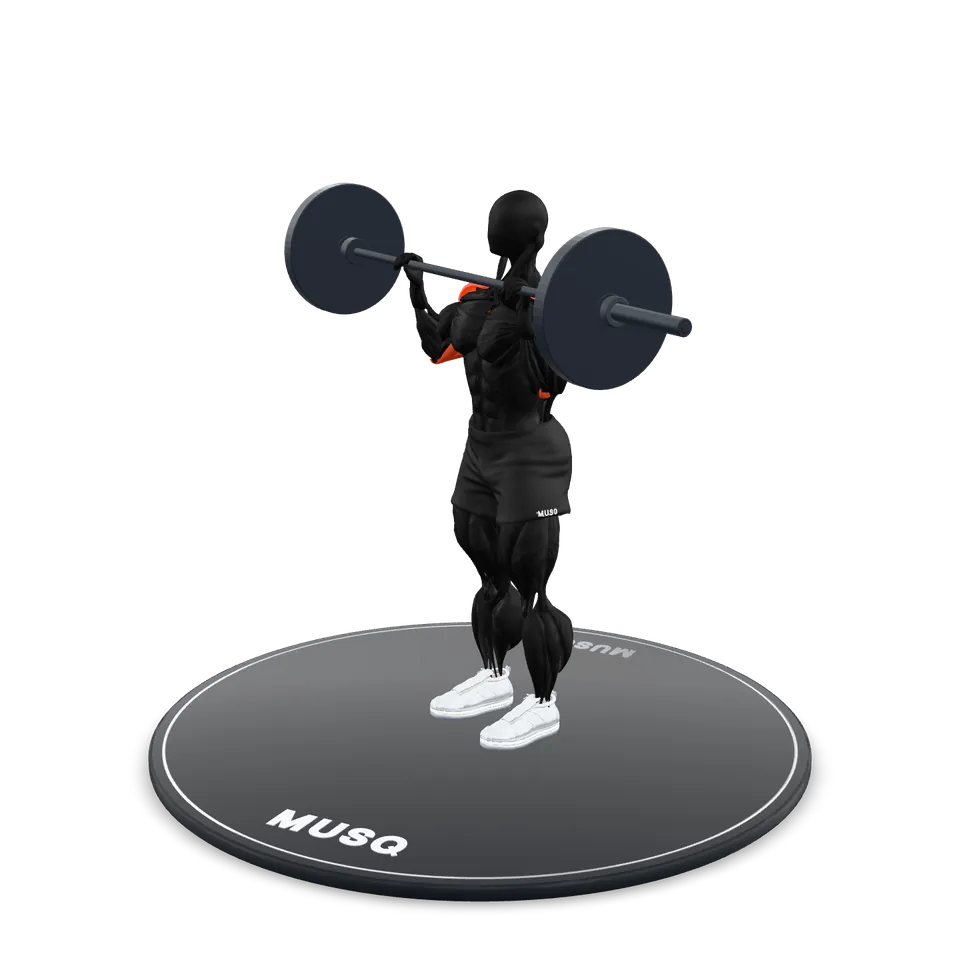
The barbell overhead press, also called the military press or strict press, builds strong shoulders by pressing a bar from your collarbones to straight arms overhead. It trains the front and side delts and the triceps, and asks your whole trunk to stay braced while you stand under the load.
- Primary muscles
- Anterior Deltoid, Lateral Deltoid
- Equipment
- Barbell
- Level
- Intermediate
- Sets × reps
- 3–5 × 5–8 for strength · 3–4 × 8–12 for size
- Rest
- 2–3 min
Muscles worked
Estimated activation, matching the orange paint on the 3D model.
- Anterior Deltoidprimary
- Lateral Deltoidprimary
- Triceps Brachiisecondary
How to do the barbell overhead press
- Set the bar in a rack at upper-chest height and grip it just outside shoulder width, wrists stacked over your forearms.
- Step out with the bar resting on your front shoulders and collarbones, feet about hip width apart.
- Brace your abs and squeeze your glutes so your ribs stay down and your lower back doesn't arch.
- Pull your chin back and press the bar straight up, close to your face.
- Once the bar passes your forehead, move your head forward so the bar finishes over the middle of your foot, arms locked out.
- Lower the bar under control back to your collarbones, moving your head back out of the way.
Form cues and common mistakes
The same coaching points MUSQ shows on the lifter in the app.
Grip & Forearms
The press starts from the rack position, and the forearms set its line.
Why it mattersWith the wrists stacked over vertical forearms, force travels straight up into the bar instead of bending the wrists back.
Common mistakeA grip so wide or a wrist so cocked that the bar rolls onto the fingers and drifts forward.
Do this insteadGrip just outside the shoulders with the bar low in the palm, forearms vertical and elbows slightly in front of the bar.
Bar Path
The bar should rise in a straight vertical line over the middle of the foot.
Why it mattersA vertical path keeps the load balanced over the base; a bar that loops forward lengthens the lever on the shoulders and lower back.
Common mistakePressing the bar out and around the face so it finishes in front of the head.
Do this insteadPull the chin back to clear a straight path, press the bar close to the face and finish directly over mid-foot.
Head Position
The head moves out of the way on the way up and back in at the top.
Why it mattersBringing the head through under the bar at lockout stacks bar, shoulders and hips, so the deltoids and triceps finish the rep without the lower back compensating.
Common mistakeLeaving the head back at lockout, which parks the bar in front of the body.
Do this insteadOnce the bar passes the forehead, push the head forward under it and finish with the arms beside the ears.
Trunk Bracing
Standing overhead work is only as stable as the trunk under it.
Why it mattersSqueezing the glutes and keeping the ribs down stops the lower back arching, which would turn the lift into a steep incline press.
Common mistakeLeaning back to press, over-arching the lumbar spine to get the bar up.
Do this insteadBrace the abs, squeeze the glutes and keep the ribs stacked over the pelvis on every rep.
Base
A strict press gets no help from the legs.
Why it mattersLocked knees and a hip-width stance keep the effort on the shoulders and triceps and give a stable base to press from.
Common mistakeDipping the knees to bounce the bar up, which turns the press into a push press.
Do this insteadStand with the feet about hip-width, knees locked and weight balanced over mid-foot for the whole set.
● Free on the App Store
Train every lift in 3D with MUSQ
Nearly 500 exercises in 3D, x-ray set-up demos, stretching and a plan built around the days you train. MUSQ is free on iPhone.
Barbell Overhead Press FAQ
What muscles does the overhead press work?
Mainly the front and side deltoids, with the triceps finishing the lockout. The upper traps help at the top, and the abs and glutes work hard to keep you stable.
Is the overhead press the same as the military press?
Yes. Military press usually means the strict standing version with no help from the legs; a push press adds a small knee dip to drive the bar.
Why does my lower back hurt when I overhead press?
Usually because the ribs flare and the lower back arches to make the press easier. Brace your abs, squeeze your glutes and use a weight you can press without leaning back.