Shoulders · Dumbbell · Beginner
Dumbbell Lateral Raise
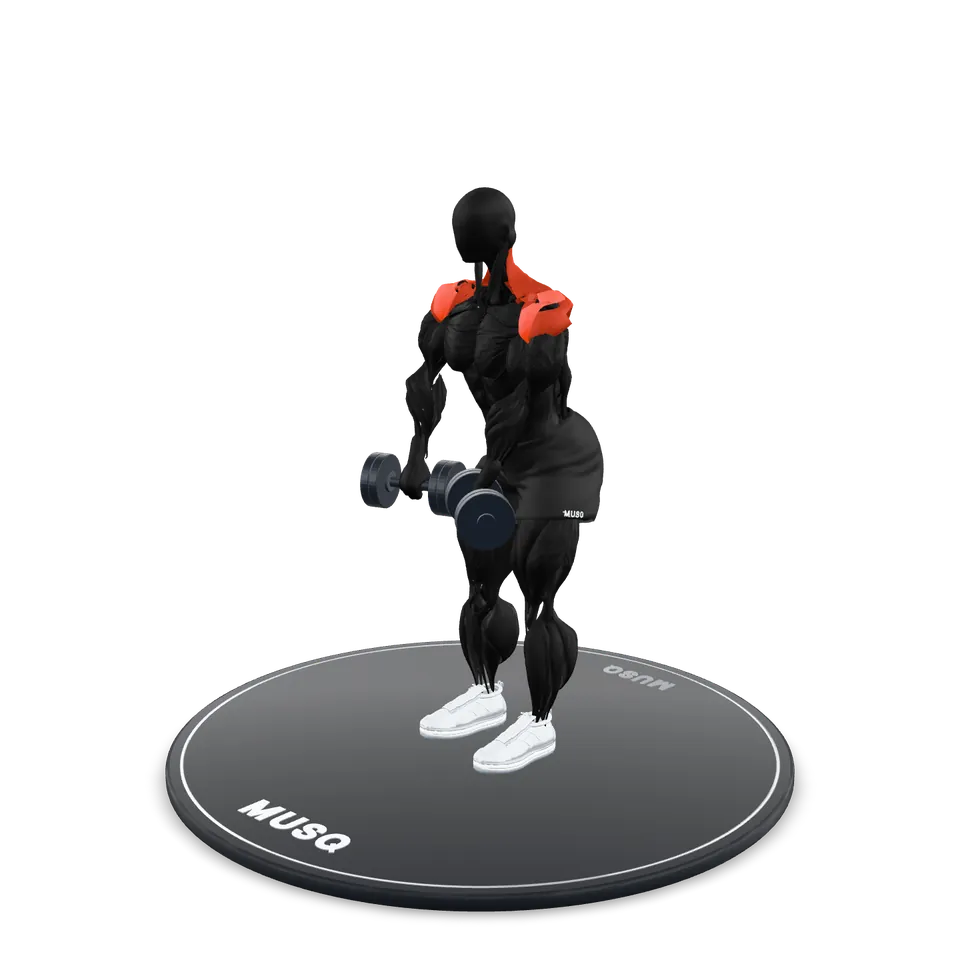
The dumbbell lateral raise isolates the side (lateral) deltoids, the muscles that make your shoulders look wider. Standing with a light dumbbell in each hand, you raise your arms out to shoulder height and lower them slowly. Light weight and strict form work far better than heavy swinging.
- Primary muscles
- Lateral Deltoid
- Equipment
- Dumbbell
- Level
- Beginner
- Sets × reps
- 3–4 × 12–20
- Rest
- 60–90 s
Muscles worked
Estimated activation, matching the orange paint on the 3D model.
- Lateral Deltoidprimary
- Anterior Deltoidsecondary
- Upper Trapeziussecondary
- Posterior Deltoidsecondary
How to do the dumbbell lateral raise
- Stand with your feet about hip width apart and a dumbbell in each hand at your sides, palms facing in.
- Bend your elbows slightly and keep that angle fixed for the whole set.
- Keep your shoulders down, away from your ears, and your chest up.
- Raise the dumbbells out to the sides, slightly in front of your body, leading with your elbows.
- Stop when your arms reach shoulder height, with your hands no higher than your elbows.
- Lower the dumbbells slowly back to your sides without letting them swing.
Form cues and common mistakes
The same coaching points MUSQ shows on the lifter in the app.
Shoulder Position
A lateral raise is a deltoid exercise, not a shrug.
Why it mattersKeeping the shoulders down stops the upper trapezius taking over the top of the lift.
Common mistakeShrugging the shoulders toward the ears as the dumbbells rise.
Do this insteadKeep the shoulder blades down and the neck long, and lead the movement with the elbows rather than the hands.
Arm Path
The arms rise slightly in front of the body, not straight out to the side.
Why it mattersRaising the arms about 20–30° forward lines the lift up with the shoulder blade and keeps the joint comfortable.
Common mistakePulling the arms back behind the body at the top, which pinches the shoulder.
Do this insteadKeep the dumbbells slightly in front of the hips on the way up, with the hands level — neither thumbs nor pinkies tipped up.
Elbow Bend
The arm is a fixed lever for the whole raise.
Why it mattersA slight, constant elbow bend keeps the load on the lateral deltoid; bending further as you lift shortens the lever and hands the work to the traps.
Common mistakeBending the elbows more as the dumbbells rise, turning the raise into an upright row.
Do this insteadSet a soft bend in the elbows at the bottom and hold exactly that angle up and down.
Range of Motion
The lateral deltoid does its work between the side of the body and shoulder height.
Why it mattersRaising to about shoulder height loads the lateral deltoid fully; going higher shifts the effort onto the upper trapezius.
Common mistakeSwinging the dumbbells up past the head, or stopping well short of shoulder level.
Do this insteadRaise until the arms are roughly parallel to the floor, pause briefly, then lower under control.
Torso Control
Momentum is the most common way to cheat this lift.
Why it mattersA still torso makes the lateral deltoid lift the weight from a dead stop instead of borrowing speed from the hips.
Common mistakeRocking the torso to swing heavy dumbbells up.
Do this insteadStand tall with soft knees, brace the core and raise the dumbbells without any body swing.
● Free on the App Store
Train every lift in 3D with MUSQ
Nearly 500 exercises in 3D, x-ray set-up demos, stretching and a plan built around the days you train. MUSQ is free on iPhone.
Dumbbell Lateral Raise FAQ
What muscles do lateral raises work?
Mainly the lateral (side) deltoid. The front delt, rear delt and upper traps help, especially when the weight is too heavy or the shoulders shrug.
How high should you raise your arms in a lateral raise?
To about shoulder height. The side delts do most of their work up to that point; going higher mostly shifts the effort to the traps.
Why don't I feel lateral raises in my shoulders?
Usually the weight is too heavy, so the traps shrug it up or the body swings it. Drop the weight, keep the shoulders down and raise slowly with a fixed elbow bend.